Life on Grass
Finishing cattle on pasture requires careful management of grass. To produce succulent tender meat, animals must be gaining weight on lush, high-quality forage. The animals’ grazing patterns must be carefully controlled and monitored or the grassland will be grazed too little or too much, compromising its quality and availability. Because of all the attention devoted to the forage, some people who raise grassfed animals refer to themselves as “grassfarmers” rather than ranchers.
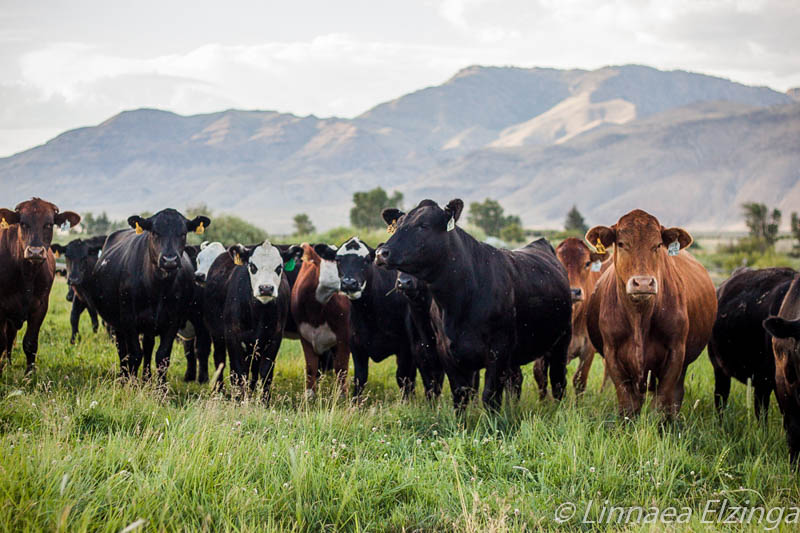
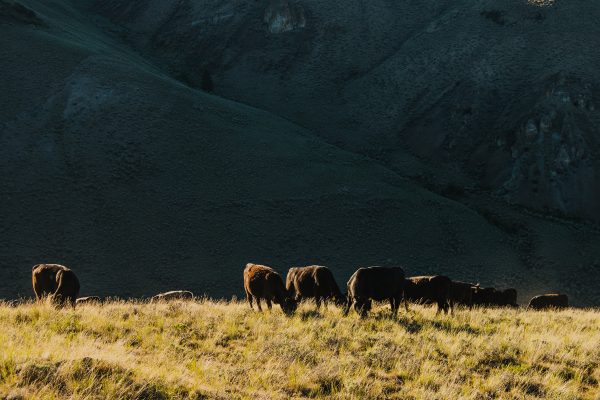
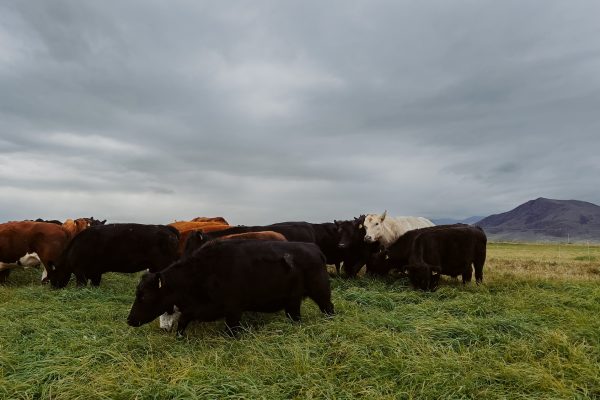
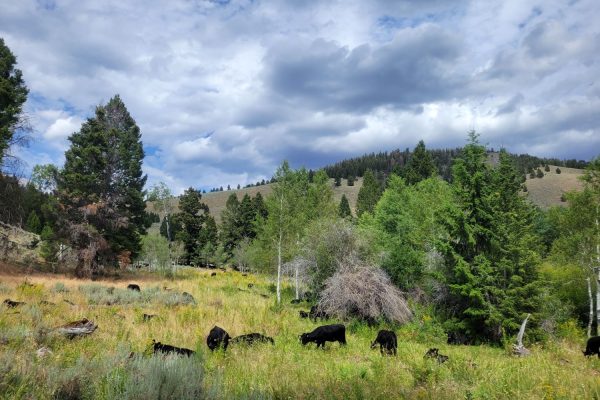
We think our cattle have it pretty good. For much of the year, they roam our green pastures, eating lush grass and forbs, drinking clean water from creeks and springs (see our environmental benefits page for descriptions of how we keep our cattle from polluting their own water sources). In the winter, we bring them sweet smelling hay, fed by our team of Suffolk Punch draft horses. Our cattle come when called. Even the “wild” cows we occasionally buy from neighboring ranches usually settle down under our intensive pasture management.
Glenn found that it was more efficient to work cows alone, rather than hiring help who believe cattle have to be “cowboyed”. This allows him to give the cows their needed shots and health treatments peacefully. We subscribe to the Bud Williams method of cattle handling: by careful positioning of our bodies (or on horseback) cattle can be made to move with a minimum of stress and disturbance.
When one of our animals gets sick and needs treatment, we try to avoid forcing them into a corral and head catch. Instead, we use a bow and arrow device that shoots a syringe and needle.
This low stress translates into healthier animals that are rarely sick. It also produces better quality meat. USDA research shows that often tough beef is caused by the physiological changes that take place in an animal due to the extreme stress just before processing. We go to great lengths to protect our cattle from stress, both because our cattle deserve our humane respectful treatment, and because it gives you tender delicious beef.
LINKS AND ADDITIONAL READING
The Stockman Grass Farmer is a magazine written promoting grass based agriculture.
Michael Pollan’s The Biography of an Industrial Beef Cow is a must-read if you eat beef. The description of the life of his steer, #534, describes in detail the typical past life of the steak in your local grocery store. Well-written and interesting, this article will only take you 10-15 minutes. The life of #534 is the antithesis of the lives of animals grown at Alderspring Ranch. After reading this article, you will understand why we believe that raising beef solely on grass is ethically and ecologically the right thing to do.
Feedlot Diets Are a Recipe for Animal Discomfort and Disease
Jo Robinson at Eat Wild identifies 5 problems with feedlot diets:
- On pasture, acids produced by the normal ruminant digestion are neutralized by saliva. On feedlot diets, cattle produce less saliva because the low-roughage feed des not require lengthy rumination in the gut. The result is high levels of acidity in the digestive system which leads to several other problems.
- Over time, acidosis can cause inflamation of the digestive system wall. Eventually ulcers may develop and the animal’s gut no longer absorbs nutrients as efficiently.
- The ulcerated digestive system allows gut bacteria to escape and enter the bloodstream, potentially causing abcesses in the liver. Up to 30% of feedlot cattle may have liver abscesses.
- All ruminants produce gas in the digestive system as a by-product of digestion. When cattle are on a diet artificially high in protein, the gases can become trapped by a dense mat of foam and the animal bloats. In serious cases of bloat, the rumen becomes so distended with gas that the animal is unable to breathe and dies from asphyxiation.
- When the rumen becomes too acidic, an enzyme is produced which destroys thiamin or vitamin B-1. The lack of vitamin B-1 causes paralysis by depriving the brain of necessary energy. Cattle that are suffering from feedlot polio are referred to as “brainers.”
Typically, these problems are treated in feedlots by ionophores (to buffer acidity) and antibiotics (to reduce liver abscesses).
What feedlot beef may be fed:
Pot-scrubbers
Feedlot cattle require some roughage in their diet in addition to grain-based concentrate. Researchers thought pot scrubbers might be effective roughage, and tested the idea by inserting pot scrubbers into the rumens of feedlot steers. They found that steers with the scrubbers gained 16% more! (Loerch, S.C. 1991. Efficacy of plastic pot scrubbers as a replacement for roughage in high-concentrate cattle diets. Journal of Animal Science 69:2321-2328.)
Stale chewing gum (with the wrappers)
Research found that the chewing gum and packing material “can replace up to 30% of corn-alfalfa diet for growing steers with advantages for improving dry matter intake and digestibility.” (Wolf, B.W. et al. 1999. Effects of a return chewing gum/packing material mixture on in situ disappearance and on feed intake, nutrient digestibility, and ruminal characteristics of growing steers. Journal of Animal Science 77:3392-3397.)



Leave a Reply