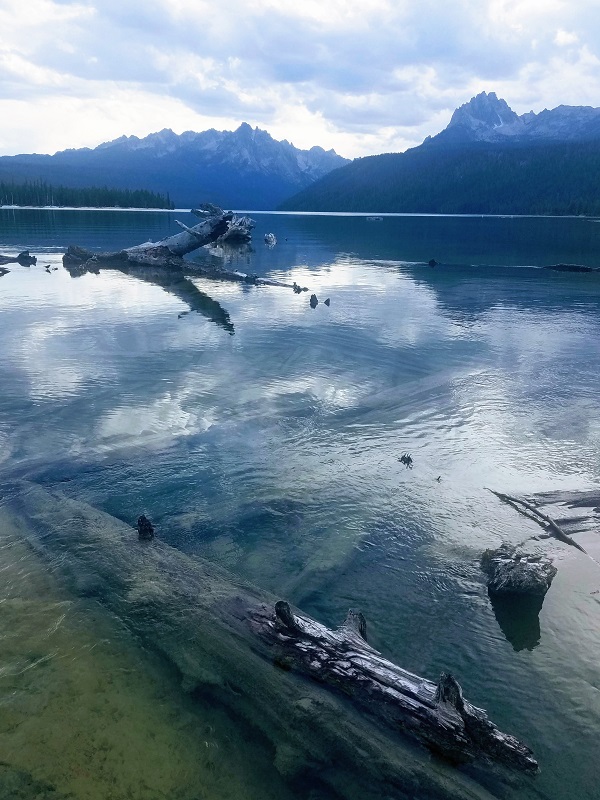
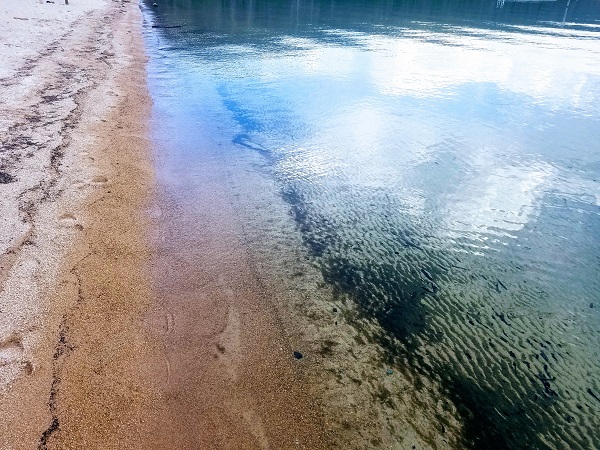
 I walk barefoot in the coarse granitic sand and turn back to see what is happening to my footprints. They have vanished, swept away by the incessant waves that pound the beach. I look across the lake. It is a fair-sized lake, 5 to 6 miles long, I think. It is long enough that the horizon is flat, meaning the curvature of the Earth defines what I can and can’t see on the opposite shore. The beaches and shoreline rocks are lost behind the bulge of whitecap waved water.
The lake is crystal clear. I’ve canoed on it several times as I am today and know that the bottom is clear at 20 feet. Then darkness takes over, and the unsettling depths are hard to perceive. Shafts of sunlight pierce downward along the shade of my canoe. My blond-haired daughters hang over the edge of the red canoe gunwale to see big fish down there. “What are they?†they ask. “Are they salmon?â€
“They aren’t salmon.†I say, as I wield my paddle, and watch the whirlpools that emanate from it. “They are most likely all spawned out right now, and there are only a few returnees from the ocean these days.†Fisheries biologists have started to rebuild the species from just a few fish in starting in 1991. In 1992, only one fish made the long journey from the sea to this lake, known as Redfish Lake.
They named him Lonesome Larry. He came back to Redfish to spawn and found no females. Larry was the last known survivor, in that year, of an entire race of Sockeye Salmon that returned to Idaho’s Sawtooth mountains. A few more fish returned over subsequent years. All of these were captured and spawned out in captivity for a total number of 16 Sockeye. These stragglers marked the end of the wild originated migration. It was over.
It is hard to know what prehistoric numbers used to be on a yearly basis. Some estimates range into the millions of fish that spawned each year in 5 or six lakes in the Sawtooth Basin. As recently as the 1960s, tens of thousands of Sockeye still made the tortuous journey up to Redfish lake to spawn. They turned red as they made the last part of their journey, hence the name of the lake, “Redfish.â€
In the past, starting in July, Redfish Lake’s shores were clogged with spawning salmon, jamming the granitic gravel and sandy shallows along the lake. The whitecapped waters that rolled over the buried eggs in the lake margins kept the eggs well oxygenated. The adult females and males died, their spent bodies washed up on the beach soon after they spawned. Their purpose, their meaning had been realized. Another generation would begin.
In several ways, Redfish Sockeye were toughest of them all. They traveled the greatest distance in fresh water (900 miles), gained the most elevation (6500 feet), and were the most southern outpost (44 degrees latitude) of a cold-water fish species that reaches all the way to the Bering Sea. They survived the worst that nature handed out but could not survive what men did to their passage in the 1970s. They dammed it.
Their impressive migration cycle was nearly forever broken when many power generation and irrigation diversion dams were built along the Snake and Columbia Rivers by the Bureau of Reclamation. Even with fish ladders, it was the near end of a species. The window slammed shut, and nearly all the Sockeye disappeared. Extinct.
Now, thanks to Idaho Department of Fish and Game and other cooperators, from that original 16 fish, several million Sockeye have been raised and released into the wild.
However, despite such release figures, the returning contingent is weak: 159 fish made it to Redfish last year. The fish are quite literally dammed to death. But it was better than the year Lonesome Larry came all by himself. It means that there is still hope in rebuilding a species that has, by the sheer magnitude of numbers thrown into the system, adapted to crossing the dams.
Maybe, just maybe, the fish and the forests will thrive again. I mean those trees and the plants in them, along the lake. “What?†say you. “What do trees have to do with Salmon?â€
I had to confirm a suspicion.
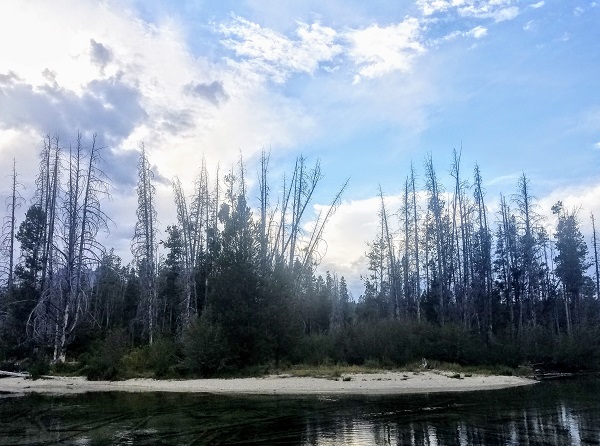
My bare feet left the beach into the prickly pine needle and cone covered forest floor to look at some tree stumps of trees that had succumbed to the massive mountain pine beetle outbreak that had killed half the trees along the shoreline in recent years. The Forest Service had cut down the dead trees that they feared were a hazard to recreationists enjoying the lake shore. Most of the forests along the lake were in poor condition, getting pounded by the beetle. Trees that are unhealthy from drought or other factors often succumb to insect infestations.
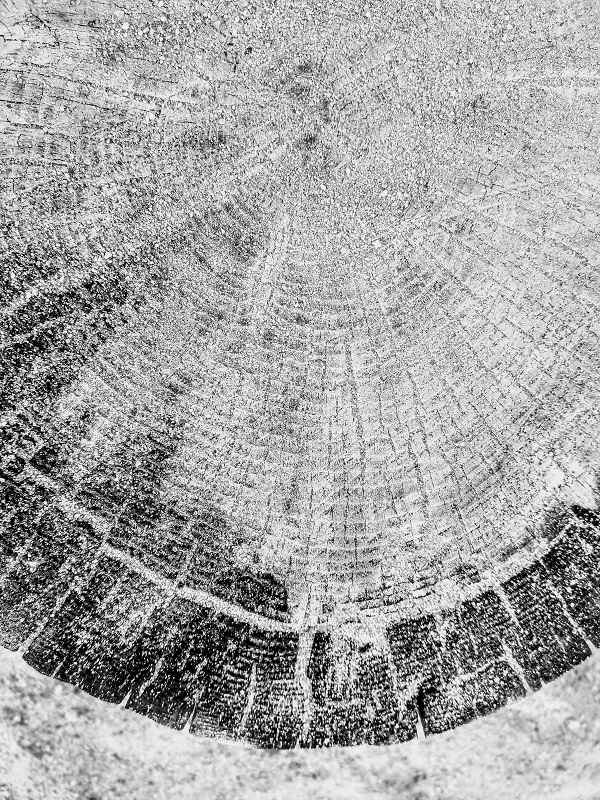
There might me a clue in those stumps as to what changed in their wellness portfolio. I knelt for a close look and found there written in the exposed tree rings the story of the significance of the Sockeye.
On nearly each tree stump I could read rings on, when I counted 60 years back from the present, to the 1950s and 60s, the trees were growing wildly faster. Trees were putting on up to 5 times the diameter growth per year than in recent years.
It was exactly the time the Sockeye were still coming up to Redfish in the tens of thousands. Eagles, ospreys, ravens and bears came to feast on the bounty of exposed and rotting flesh that baked in the sun along windward beaches. The feasting carrion lovers dragged their booty up into treetops and onto the forest floor along the margin of the lake. By my conservative estimates, there were easily 180 tons of fish on that beach every year.
And what those feasting on the bounty dropped as table waste the ants swept up, backpacking into the ground to feed great ant colonies. Yellowjackets fed great yellowjacket colonies.
And then they all pooped and peed. A lot. And the trees they roosted on and dined under took note.
Rain and snow sent the nutrients deep into the ground, where tree roots of lodgepole pine, Engelmann spruce and subalpine fir awaited them. And the trees grew, leaving a secret record of tree rings embedded deep inside them that would someday tell the reader of such a tale of how the rich nutrients of krill and plankton from deep in the Pacific Ocean 7000 miles away was transported by a red fish and built a strong lodgepole pine or stately spruce in a verdant Idaho forest.
It is a story of the power of natural fertilizer and nutrient cycling, and how we probably should respect these natural systems before we alter them. There’s a long list of repercussions when we fiddle around with nature’s elegance.
And so, it is with us, here on the ranch. When we stop to see lessons from the likes of tree rings, it has great bearing on how we raise your food. It trains us to observe nature on our wild ranges in everything to when the elk calve and how bison grazed. It teaches us to read the story left by dying aspens and their lack of regeneration (could cows be herded away from regenerating trees to let them grow? Yes, of course).
Can we time our herds calving season to the same as the elk’s and have healthier calves and mammas? Why yes, and it’s no surprise it works. Could we train our beeves to eat like bison? Yes, we can. Can we graze a high diversity of green plants that fits their reproductive life cycles while maximizing our beeves wellness? Yes, and we do.
What that means is that you get to benefit. Because when we follow the example of nature, you’ll invariably get to enjoy a greater nutrient density and wellness from that protein. You’re like a lodgepole pine, whose tree rings tell the story of health and wellness, when you live on food designed not by us, but by nature.
Thanks for partnering with us as we learn from the best teacher.
​​​​​​​Glenn, Caryl, Cowboys & Cowgirls at Alderspring Ranch